


AutoSmart Parts
Pure Sine Wave Inverter 6000W Peak Heavy Duty, 3000W Continuous for RV Home Backup
3000W continuous, 6000W peak for air conditioning, power tools and home backup. This heavy duty pure sine wave inverter handles the jobs that smaller units simply cannot.
Regular price
$899.99 AUD
Regular price
$999.99 AUD
Sale price
$899.99 AUD
 Secure shipping
 Easy exchange
 24/7 support
 3000W continuous, 6000W peak surge power
Pure sine wave, 99.9% stable output
90% efficient with LCD error code display
Dual cooling fans for sustained high load operation
Quantity
Couldn't load pickup availability
Specifications
Specifications
Compatible With
Compatible With
What’s Included / Care Instructions
What’s Included / Care Instructions


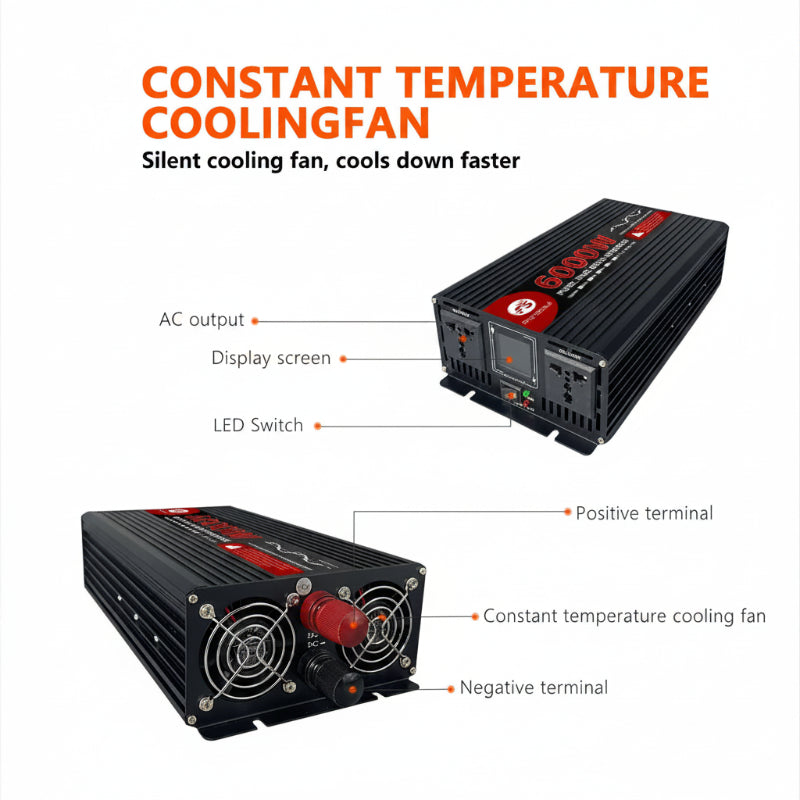
Install Guide
1. Use Thick Battery Cables
At full 3000W load this inverter pulls around 250A from a 12V battery. Use heavy gauge (2 AWG or thicker) cables and proper terminals to avoid voltage drop and heat.
2. Connect Polarity Carefully
Red to battery positive (+), black to negative (-). Reverse polarity damages the inverter immediately. Inline fuse on positive cable recommended for safety.
3. Power On and Monitor
Switch on, LCD shows input voltage and output power. Connect appliances to dual AC outlets. Keep total continuous load under 3000W (peak allowed during startup).
Common Questions Before You Buy
How big a battery bank do I need?
At 3000W load, this inverter draws roughly 250A from a 12V battery. A 200Ah battery would discharge in under an hour at full load. For sustained use plan for 400Ah+ deep cycle lithium or AGM bank, or larger.
Will it run an air conditioner?
Smaller window or RV air cons (5,000 to 10,000 BTU, around 500 to 1500W running) work fine. Large home split system air cons may exceed continuous capacity. Check your air con's rated running watts (not just BTU).
How is this different from the 3500W peak model?
This 6000W peak model has DOUBLE the continuous rating (3000W vs 1500W) and bigger surge capacity. Choose this for full RV kitchens, home backup, or running large power tools. Choose the smaller model for laptops, lighting, and basic appliances.
Why are the cables not included?
Basic battery cables are included, but high current installs (3000W continuous) benefit from heavier gauge cables sized to your specific install. We recommend 2 AWG or thicker for runs over 50cm.
Is it loud?
Dual fans run at low speed by default. Under high load (above 2000W) they speed up and become noticeable. Place the inverter in a utility area rather than a bedroom for quietest experience.